Introduction: DNase/RNase/endotoxin-free cryogenic vial claims help readers understand contamination control without confusing consumable language with total sample protection.
DNA and RNA sample storage depends on more than low temperature alone. For nucleic acid work, the container, cap, handling environment, labeling system, and sample transfer process all become part of the preservation chain. A cryogenic vial manufacturer or cryogenic vial supplier may state that a vial is DNase/RNase/endotoxin-free or Pyrogen Free, but those claims should be read as controlled consumable attributes, not as a promise that every downstream nucleic acid workflow is protected from all contamination or degradation risks.
DNA and RNA are managed as information-bearing molecules, so damage is not only a matter of visible sample loss. Degradation, enzymatic activity, repeated freeze-thaw exposure, poor handling, and contaminated contact surfaces can all affect whether a stored sample remains useful for later extraction, amplification, sequencing, or archive comparison. RNA is especially sensitive because RNases are common, stable, and difficult to control once introduced into a working environment. DNA is generally more stable, but it is still affected by nuclease exposure, chemical conditions, and sample handling history. This is why consumables used in cryogenic vials for DNA/RNA sample management are often discussed in terms of contact-surface cleanliness, packaging state, and handling discipline rather than container shape alone. The important boundary is that a vial touches the sample but does not control the entire sample journey. A vial can reduce one contact risk if its manufacturing, treatment, and packaging support a DNase/RNase/endotoxin-free claim. It cannot control whether a sample was collected into the right buffer, whether an operator used contaminated gloves, whether a pipette tip introduced enzymes, or whether the freezer workflow caused repeated warming events. In B2B laboratory language, this distinction matters because the same claim may appear in product materials from a cryogenic vial supplier, yet the responsibility for final sample integrity remains distributed across the consumable, laboratory protocol, staff training, sample type, and storage system.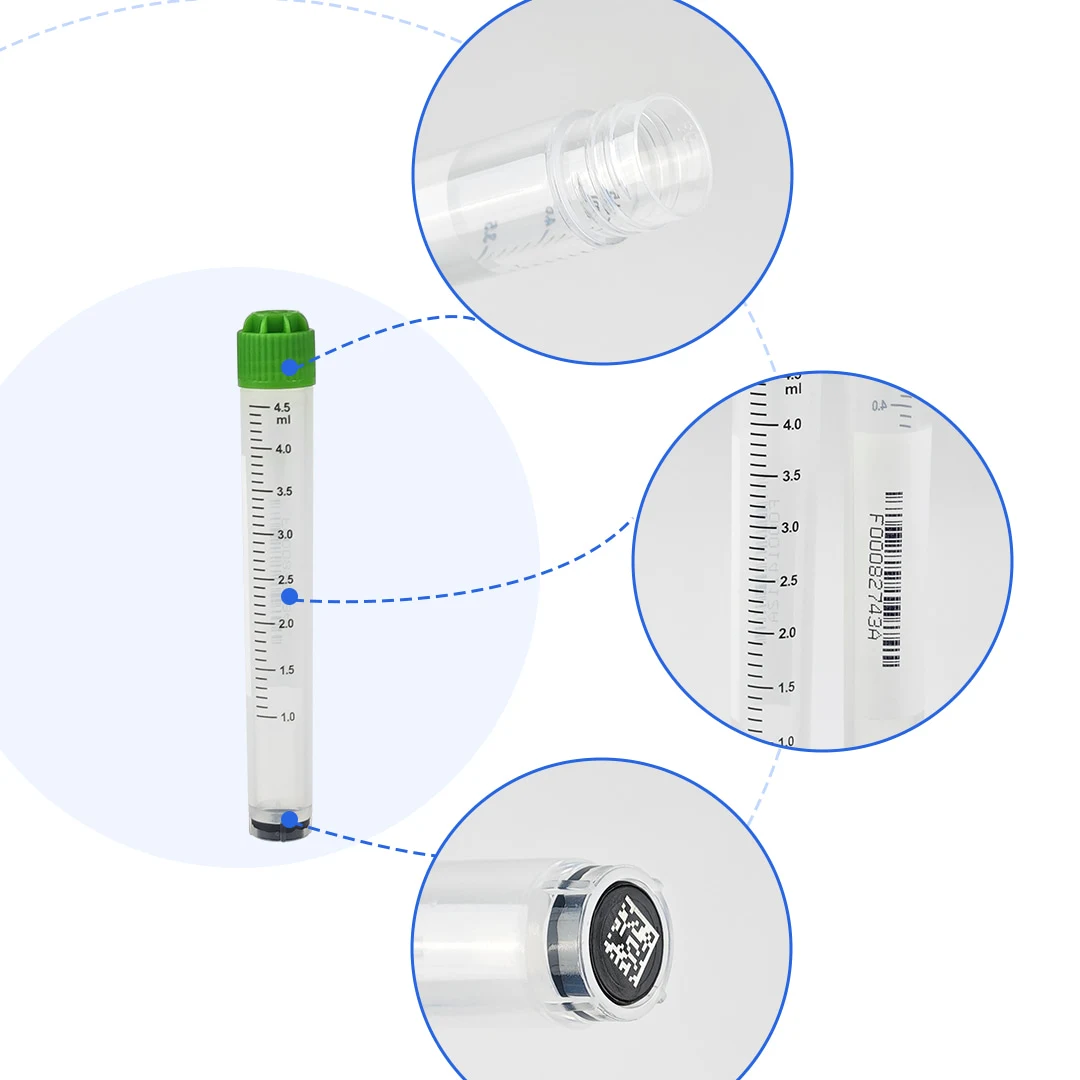
DNase/RNase-free language belongs mainly to nucleic acid integrity. It tells the reader that the vial is being positioned for workflows where enzymes capable of degrading DNA or RNA should be minimized on the contact surface. Endotoxin-free and Pyrogen Free language sits in a different conceptual layer. Endotoxins are associated with bacterial components, while pyrogen language is usually discussed in biological response and contamination-control contexts. These claims may appear together because they all relate to cleaner consumable handling, but they do not mean the same thing, and they should not be collapsed into a single phrase such as contamination-free cryogenic vials.
For DNA/RNA storage, DNase and RNase wording should be interpreted as a statement about the consumable surface and its suitability for contact with nucleic acid samples under appropriate laboratory handling. It is not a statement that the sample itself contains no nuclease, that the laboratory environment is nuclease-free, or that every molecular assay will be unaffected by storage history. A careful reader should connect the claim to the vial’s role as one controlled interface in the workflow. The vial can support nucleic acid sample management when paired with suitable collection, transfer, sealing, low-temperature storage, and documentation practices.
Endotoxin-free and Pyrogen Free wording may be valuable in biological sample management because it signals attention to contamination categories beyond nucleic acid degradation. However, pyrogen free cryogenic vials are not the same as universally clean containers for every possible biological risk. Endotoxin and pyrogen language does not replace aseptic technique, validated sample preparation, appropriate biological safety procedures, or project-specific acceptance criteria. It also should not be stretched into claims about clinical suitability, regulatory approval, or all-batch performance unless those details are specifically documented and applicable to the intended use. The safest reading is that these claims support trust in the consumable’s stated cleanliness profile while leaving the laboratory responsible for workflow control.
AMNGENT Cryogenic Vials provide a useful example of how product language can be read without overextending it. The 2D Cryogenic Vials information includes E-Beam sterilized wording, DNase/RNase/endotoxin-free language, and Pyrogen Free wording, along with Medical-Grade PP, PE screw cap, side barcode, bottom QR code, Data Matrix code, and 0.5ml to 5.0ml capacity options. For this article’s topic, the key point is not to restate every specification, but to understand how the cleanliness claims fit into DNA/RNA sample management. They indicate that the product is presented for controlled laboratory sample storage contexts where nucleic acid preservation and contamination awareness matter. That reading still has limits. The visible claims should not be rewritten as absolute nuclease elimination, universal contamination freedom, or suitability for every DNA or RNA preservation protocol. They also do not provide, by themselves, detection limits, test methods, batch report numbers, sterility assurance levels, or a guarantee that every downstream molecular workflow will perform as expected. Readers evaluating AMNGENT Cryogenic Vials should treat the claims as relevant consumable information and then align them with their own sample type, handling process, documentation needs, and internal quality requirements. This is especially important when the same vial also includes traceability features such as side barcodes and bottom codes, because identification control and contamination control support different parts of sample management. For a knowledge learner, the practical value is a better mental model: a cryogenic vial manufacturer can provide a container with declared material, coding, sterilization, and cleanliness attributes; a laboratory applies those attributes inside a complete process. The manufacturer or cryogenic vial supplier language helps define what the consumable is intended to support, while the user’s protocol defines whether that support is enough for a particular DNA or RNA sample. This is a more reliable interpretation than treating DNase/RNase/endotoxin-free cryogenic vial language as a single all-purpose safety label.
DNase/RNase/endotoxin-free and Pyrogen Free claims are meaningful, but they are boundary terms. They help readers understand how cryogenic vials can reduce specific contact-surface risks in DNA and RNA sample storage, while leaving sample preparation, handling environment, storage discipline, and project validation in the laboratory’s control. AMNGENT Cryogenic Vials can be read as a product example where these claims sit alongside coding, material, cap, and capacity information. The strongest interpretation is conservative: use the claims to understand the vial’s declared role, then confirm whether the full workflow matches the sample’s risk profile.
Q:What does DNase/RNase-free mean for cryogenic vials used in DNA and RNA sample storage?
A:DNase/RNase-free means the cryogenic vial is presented with a consumable-level claim that DNA- or RNA-degrading enzyme risk is controlled within the stated product claim scope. For DNA and RNA sample storage, this matters because the vial is a direct contact surface. It does not mean the sample, operator, pipette tips, freezer, or full workflow is free from nuclease risk.
Q:Are pyrogen free cryogenic vials the same as contamination-free cryogenic vials?
A:No. Pyrogen Free is a specific contamination-control claim and should not be rewritten as contamination-free. A vial may be described as pyrogen free while still requiring correct sample handling, compatible storage conditions, controlled transfer steps, and project-specific quality checks. It supports a cleaner consumable profile but does not remove all contamination risks.
Q:How should AMNGENT Cryogenic Vials claims be read in DNA/RNA sample management?
A:AMNGENT Cryogenic Vials claims such as DNase/RNase/endotoxin-free and Pyrogen Free should be read as consumable-level statements relevant to DNA/RNA sample management. They can help readers understand the vial’s intended cleanliness profile, but they should not be expanded into guarantees of absolute nuclease removal, universal contamination freedom, or suitability for every nucleic acid workflow.
QIAGEN DNA and RNA Sample Storage
Laboratory biosafety manual fourth edition


