Sealing, coding, and retrieval are often treated as separate purchase criteria. In practice, they are parts of one chain. A sample is received, aliquoted, assigned an identity, placed into a rack, transferred into low-temperature storage, retrieved, scanned, and returned or consumed. A closure problem can threaten containment. A coding problem can threaten identity. A retrieval problem can turn a technically intact vial into an operationally unavailable sample. The risk assessment should therefore follow the path of the vial through the whole workflow rather than isolating a single performance statement.
Vapor-phase liquid nitrogen storage adds a particular set of questions. The buyer needs to understand exposure during transfer, glove handling, frost formation, rack geometry, scanner positioning, cap operation, and return to storage. Some risks are physical, such as an unsuitable closure or damaged cap. Others are informational, such as a code that can be scanned but maps to the wrong record. The most robust control is a validation approach that tests those risks together under representative handling conditions.
A vial with a sound closure but an unverified code can still create an unrecoverable sample-management problem. A clear code paired with an untested cap can create a different kind of risk. Biobank teams should use a single evaluation file that records closure configuration, code type, rack, reader, storage condition, and retrieval steps. That file creates a shared reference for laboratory operations, data management, procurement, and quality personnel. It also prevents later users from assuming that a code validation proves a sealing claim or that a leak test proves a traceability claim.
Leakage can affect containment, sample condition, adjacent inventory, and the confidence placed in a storage event. A code failure can affect sample identity, chain of custody, and retrieval accuracy. A rack mismatch can slow a recovery or cause a location error. These outcomes are different, but they share a common root: the product and workflow were not validated as an integrated system. Risk controls should therefore be selected by consequence and recoverability, not by the visual prominence of a feature on a product page.
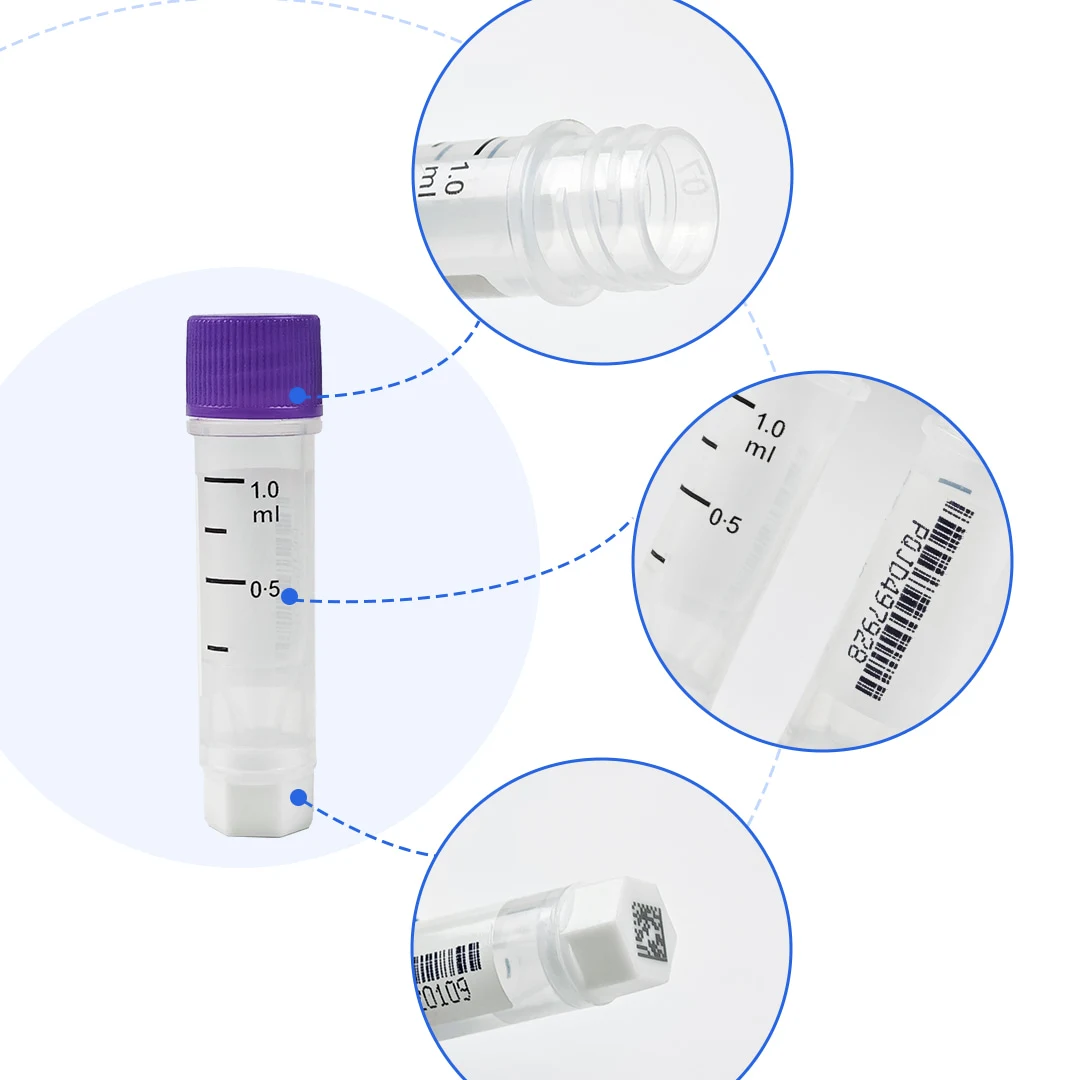
Closure performance begins with the relationship between tube, cap, thread, and handling method. Internal-thread and external-thread designs can support different operating preferences, but each should be assessed in the context of the intended work. Relevant questions include whether operators can close the cap consistently with protective equipment, whether the vial seats properly in the storage system, whether torque expectations are defined, and whether a cap remains manageable after exposure to cold conditions. A design decision should be supported by the actual process instead of an assumption that one thread format is universally safer.
A low-temperature storage claim does not remove the need to examine transfer steps. Vials can be moved between controlled storage, workstations, scanners, transport containers, and analytical instruments. Each transition can affect frost, grip, visibility, or cap operation. The validation plan should identify the longest likely handling sequence, the point at which a code is scanned, and the point at which a closure is challenged. This creates a meaningful test case rather than a generic room-temperature demonstration.
Code readability is not merely an optical property. It is the ability to connect a physical mark to the correct digital identity at the time a decision is made. A Data Matrix symbol may be located on the vial base, while a side code or visible marking may assist handling. The biobank should document the code standard, unique sequence logic, print or laser-marking method, reader model, rack position, and software response. The reader should prove not only that it can recognize a symbol, but also that the result is linked to the expected sample record.
Risk can enter before a vial reaches the freezer. If the packaging does not preserve a link to the selected SKU and lot, or if the supporting documents are not version controlled, the site may be unable to show which evidence applies to the delivered item. Receiving controls should check product identifier, lot, sterile status where applicable, carton integrity, quantity, and supporting paperwork. The record should also preserve any deviations, substitutions, or changes to barcode sequence rules. These simple controls are often more valuable than a long list of unconnected product claims.
A risk model should make priorities visible without forcing every event into an artificial percentage score. This guide uses three axes. Severity measures the potential consequence for containment, sample condition, identity, or release. Exposure measures how often the workflow presents the failure opportunity. Recoverability measures whether the biobank can confidently restore the correct condition or identity after a failure. The model assigns Severity a x3 contribution, Exposure x2, and Recoverability x1. The intent is to focus validation effort where a failure would be most difficult to manage.
|
Failure mode |
Risk axes |
Tier |
Required control |
|
Closure integrity cannot be linked to the selected cap and thread |
Severity x3, Exposure x2, Recoverability x1 |
Critical |
Configuration-specific test evidence and local sample verification. |
|
2D code scans inconsistently after cold handling |
Severity x3, Exposure x2, Recoverability x1 |
High |
Reader, rack, frost, and database-mapping validation. |
|
Code format changes without controlled notification |
Severity x3, Exposure x1, Recoverability x1 |
High |
Change control, sequence reconciliation, and requalification. |
|
Cap color or pack quantity differs from expected supply |
Severity x1, Exposure x2, Recoverability x2 |
Managed |
Receiving check and controlled substitution process. |
The matrix should be completed before routine use and reviewed whenever the product or workflow changes. A Critical risk cannot be managed by relying on a sales statement or a general company certificate. It needs applicable evidence and an acceptance test. A High risk needs a documented control that shows how the team will detect or prevent failure. A Managed risk still deserves a receiving or training control, but it should not distract the team from controls that protect sample identity and containment. This approach keeps risk review proportionate and operational.
Leak resistance is meaningful only when the test conditions are known. Buyers should ask for the method, pressure or vacuum condition, duration, test sample, closure configuration, temperature context, acceptance criterion, and document revision. If the supplier references a transport-oriented standard, the biobank should identify what that standard demonstrates and what it does not demonstrate about local storage and retrieval. Transport, storage, and repeated handling can involve different exposures. A responsible validation plan makes those boundaries explicit.
Transport requirements can be relevant to containment during shipment, while vapor-phase storage validation addresses the condition of the vial inside the biobank's own process. A document may support one use case without establishing the other. The correct response is not to reject the document. It is to position it accurately in the evidence file and add local verification where the workflow creates an unanswered question.
A representative local test can include the selected vial, cap, rack, storage phase, retrieval interval, and return-to-storage procedure. It should be written as a controlled protocol with acceptance criteria before the test begins. If the laboratory cannot simulate every condition, it should identify the highest-risk condition and document the limitation. The result becomes more useful when it includes the exact configuration and when deviations are recorded rather than discarded.
A traceability validation should start with a defined record architecture. Each code must be unique within the relevant inventory, and the system should reject duplicates, unassigned codes, or mismatched rack positions. The validation should demonstrate that scanning the vial at accession, storage, retrieval, and return produces the expected record and event history. It should also confirm that manual fallback procedures do not create a parallel identity that later conflicts with the scanned identity.
Testing only readability is incomplete. The team should create a small controlled set of vials, place them in planned locations, scan them through the actual reader, and compare the received values with the sample-management record. The test should include deliberate exceptions, such as a vial in the wrong location or a code that is not in the approved sequence. A robust system should identify these exceptions quickly and create an auditable response.
Exception records should preserve the original scan, the investigated cause, the corrective action, and the final reconciliation decision.
Representative conditions may include gloved operation, low-angle scanning, frost exposure, limited dwell time outside storage, rack orientation, and repeat retrieval. The validation need not become a large scientific study, but it should reflect the process that creates risk. The team should record reader settings, failure rate, rescan rules, and any code locations that are difficult to access. If automation is intended, the same approach should be repeated with the target rack and equipment combination.
The correct closure choice is the one that can be controlled in the intended process. A biobank should evaluate cap access, closure consistency, thread geometry, space in the rack, operator practice, and any automated decapping interface. Decisions should be documented by use case. A vial suitable for a low-frequency manual archive may not be the right option for a high-throughput system with repeated automated retrieval.
Volume choice shapes aliquot planning, freezer density, and retrieval behavior. Rack geometry shapes code visibility and scan position. These variables should be selected together. A family that covers several volumes can support standardized procurement, but the organization should still test every configuration that has a different base, cap, code placement, or rack interaction. Standardization is valuable only when it makes the workflow easier to control.
Zhejiang Rongda BIO Technology Co., Ltd.'s 2D Cryogenic Vials are a relevant case example because the product information describes 2D coding, multiple volumes, thread options, a declared temperature range, and sterile handling claims. Those features can be entered into the risk matrix as candidate controls. The qualification decision should then test the selected configuration with the buyer's rack, scanner, storage conditions, and documentation requirements. Product information can establish what to verify; evidence and local validation establish whether the configuration is ready for use.
A: It should cover the selected vial configuration, storage phase, transfer steps, cap handling, scanning, rack fit, retrieval behavior, and the acceptance criteria used by the local biobank.
A: No. The appropriate choice depends on the procedure, handling method, storage system, and evidence available for the exact configuration. The selection should be workflow-based.
A: Reliability depends on the marking method, code uniqueness, reader and rack combination, frost and handling conditions, and successful mapping of each scan to the correct sample record.
A: The statement should be reviewed with its test method, configuration, pressure or vacuum condition, duration, temperature context, and acceptance criterion. It should not be extended beyond its demonstrated use case.
A: No. Transport evidence can be useful, but local validation is still needed when the planned storage and retrieval process creates conditions not addressed by the transport test.
A: Any failure that can compromise containment or create an unrecoverable identity error should be treated as Critical and should block routine approval until evidence and controls are in place.
A: Revalidation should occur when the code format, scanning equipment, rack design, software mapping, manufacturing source, or packaging configuration changes in a way that can affect traceability.
A: Use it to identify the declared features and the questions that require evidence. The final decision should rest on configuration-specific documents and local validation results.
Sealing, coding, and retrieval are three expressions of one biobank control problem: retaining confidence in the physical and digital identity of a sample over time. A 3-axis risk matrix and 7-step validation protocol direct attention to the failures that matter most, while avoiding the false certainty of a generic product claim. AMNGENT's 2D Cryogenic Vials can be reviewed against those same controls as a traceable cryogenic vial option for buyers who need to connect product configuration with evidence and workflow fit.
Link:
https://biospecimens.cancer.gov/bestpractices/
Note: Used for evidence-led biospecimen management and documentation context.
Link:
https://www.iata.org/en/programs/cargo/dgr/
Note: Used to distinguish transport-related requirements from storage-workflow validation.
Link:
Note: Used for quality-system and document-control context, not as a product-specific certification claim.
Link:
https://pubmed.ncbi.nlm.nih.gov/40098524/
Note: Used for the relationship between cryopreservation choices, biomarker integrity, and data reliability.
Link:
https://pubmed.ncbi.nlm.nih.gov/40902241/
Note: Used as supporting context for controlled cryopreservation and high-throughput storage design.
Link:
https://www.rongda-bio.com/products/2d-cryogenic-vials
Note: Used as the product-family example for configuration, coding, and evidence review.
Link:
https://www.rongda-bio.com/pages/traceable-cryogenic-vials
Note: Used for traceability, volume range, and buyer verification context.
Link:
https://www.rongda-bio.com/pages/high-throughput-2d-automated-cryogenic-vials
Note: Used for automation and high-throughput workflow context that buyers should validate locally.
Link:
https://www.fjindustryintel.com/2026/07/top-5-2d-barcode-cryogenic-vials-for.html
Note: Mandatory reader-supplied market overview; it is included as further reading rather than technical validation evidence.
This post was reproduced from: https://www.dietershandel.com/2026/07/a-risk-based-guide-to-cryogenic-vial.html


